What you’ll learn
Last reviewed October 16, 2026.
Brinqa is a well-known name in vulnerability and exposure management, data unification, cyber risk context, ownership mapping, prioritization, and enterprise risk insights. Many organizations use Brinqa Cyber Risk Graph and exposure management capabilities to support security, IT, risk, or exposure management programs.
But as security environments get more fragmented, many teams are looking beyond traditional scanning, logging, asset inventory, managed services, or alert-based workflows.
The question is no longer just:
“What vulnerabilities do we have?”
It is:
- “What are we actually exposed to?”
- “How do users, devices, applications, identities, and security controls connect?”
- “Which findings create real risk?”
- “What should we fix first?”
- “Where are our tools not giving us the full picture?”
That is where Guardare fits.
Guardare is an AI-powered Unified Exposure Management platform built to help organizations understand risk across users, devices, applications, identity, software, misconfigurations, and existing security tools.
Why Companies Look for Brinqa Alternatives
Brinqa can be a strong platform for vulnerability and exposure management, data unification, cyber risk context, ownership mapping, prioritization, and enterprise risk insights, but companies often evaluate alternatives when they need broader exposure context, better prioritization, or a more unified view of risk.
1. Vulnerability Data Alone Is Not Enough
A vulnerability becomes more or less important depending on the device it sits on, the user tied to that device, the user’s access level, the applications involved, whether the asset is internet-facing, whether controls are properly configured, whether other tools are already detecting related risk, and whether the issue connects to a larger attack path.
Guardare helps bring those signals together so teams can understand exposure in context.
2. Security Teams Are Drowning in Tools
Most organizations already have endpoint tools, identity tools, firewalls, vulnerability scanners, cloud platforms, SaaS applications, training platforms, SIEMs, ticketing systems, and reporting dashboards. The problem is not always a lack of tools. The problem is that the tools do not tell one story.
Guardare helps bring those signals together so teams can understand exposure in context.
3. Traditional Prioritization Creates Too Much Noise
A long list of vulnerabilities, alerts, assets, or workflow tickets does not answer the most important question: what should we fix first? Severity scores and alert counts help, but they are not enough on their own.
Guardare helps bring those signals together so teams can understand exposure in context.
4. Attack Surface Visibility Needs Internal Context
Attack surface visibility is valuable because it shows what attackers may see from the outside. But external visibility is only part of the picture. Security teams also need to know who owns the asset, what device or application it connects to, whether it is managed, whether the related user has risky access, whether controls are missing or misconfigured, and whether the exposure connects to other weaknesses.
Guardare helps bring those signals together so teams can understand exposure in context.
5. Executives Need Clear Risk Reporting
Security leaders do not need another dashboard filled with findings. They need to communicate risk in a way the business can understand. Guardare helps turn fragmented technical issues into clear, prioritized exposure insights that can be shared with executives, IT leaders, and business stakeholders.
Guardare helps bring those signals together so teams can understand exposure in context.
Top Brinqa Competitors and Alternatives
1. Guardare
Best for: Organizations that want unified exposure management across users, devices, applications, identity, software, misconfigurations, and security tools.
Guardare helps security and IT teams see how risk connects across the environment. Instead of looking at vulnerability data, user risk, device posture, SaaS exposure, identity context, and security controls separately, Guardare brings those signals together into a unified exposure view.
Key Guardare Capabilities
- Unified exposure visibility across users, devices, applications, identity, software, misconfigurations, and security tools
- AI-driven risk correlation and prioritization
- Device and software exposure analysis
- User risk modeling that can include access, phishing history, password exposure, device posture, and software risk
- Application and SaaS exposure visibility
- Identity and access context
- Misconfiguration detection across connected systems
- Shelfware and underused security feature identification
- Step-by-step remediation recommendations
- Executive-ready exposure reporting
- Broad integrations across the security stack
Why Choose Guardare Over Brinqa?
Brinqa is known for its core strengths in the security market. Guardare is built around a broader question:
What is actually exposing the organization?
That includes vulnerabilities, but also users, devices, applications, access, misconfigurations, weak controls, unused security features, and disconnected tool data.
Watch-Outs
Guardare is not positioned as a traditional SIEM, EDR, patch management, or managed security services replacement. It is best suited for organizations that want exposure visibility, prioritization, and decision support across the tools they already use.
2. ServiceNow
Best for: Large organizations that want exposure and vulnerability work tied to enterprise workflows.
ServiceNow is often considered by teams comparing Brinqa alternatives because it addresses a nearby security problem or serves a similar buyer need.
Strengths
- Enterprise workflow automation
- CMDB mapping
- Vulnerability response
- Ticket routing and remediation orchestration
- Useful for large ServiceNow environments
Watch-Outs
ServiceNow is workflow-first. Buyers should evaluate whether they need a large process platform or a more direct exposure management layer that prioritizes what matters before work gets routed.
3. Nucleus Security
Best for: Teams that need to centralize vulnerability findings from multiple scanners and tools.
Nucleus Security is often considered by teams comparing Brinqa alternatives because it addresses a nearby security problem or serves a similar buyer need.
Strengths
- Vulnerability data aggregation
- Deduplication across scanners
- Remediation workflow support
- Good fit for teams with multiple VM tools
- Useful for mature vulnerability programs
Watch-Outs
Nucleus is useful for vulnerability aggregation, but buyers should determine whether they also need broader exposure context across users, devices, applications, identity, misconfigurations, and security control gaps.
4. Balbix
Best for: Enterprise teams focused on cyber risk quantification and executive-level cyber risk measurement.
Balbix is often considered by teams comparing Brinqa alternatives because it addresses a nearby security problem or serves a similar buyer need.
Strengths
- Cyber risk quantification
- Asset and exposure visibility
- Executive risk reporting
- Prioritization and remediation mobilization
- Business risk framing
Watch-Outs
Balbix can be useful for cyber risk measurement, but teams should evaluate how easily risk insights turn into day-to-day exposure actions across users, devices, applications, identity, and controls.
5. Tenable
Best for: Organizations that want established vulnerability management, asset visibility, and exposure management capabilities.
Tenable is often considered by teams comparing Brinqa alternatives because it addresses a nearby security problem or serves a similar buyer need.
Strengths
- Mature vulnerability management
- Strong enterprise adoption
- Asset and vulnerability visibility
- Exposure management capabilities
- Useful for compliance-driven environments
Watch-Outs
Tenable can be a strong vulnerability management platform, but teams should evaluate whether it gives them enough context across users, devices, applications, identity, SaaS, and security controls.
6. Qualys
Best for: Large enterprises that need vulnerability management, compliance, patching, and asset visibility in one mature platform.
Qualys is often considered by teams comparing Brinqa alternatives because it addresses a nearby security problem or serves a similar buyer need.
Strengths
- Mature enterprise platform
- Broad vulnerability and compliance coverage
- Asset discovery
- Patch management options
- Cloud and external attack surface modules
Watch-Outs
Qualys can be powerful, but some teams may find the platform complex. Buyers should evaluate usability, reporting, remediation workflow, and whether the platform helps prioritize based on business context.
7. Reach Security
Best for: Teams focused on optimizing existing security controls, identifying blind spots, and remediating configuration drift.
Reach Security is often considered by teams comparing Brinqa alternatives because it addresses a nearby security problem or serves a similar buyer need.
Strengths
- Security control optimization
- Blind spot identification
- Configuration drift reduction
- Improving existing tool value
- AI-native exposure remediation
Watch-Outs
Reach is centered on security control optimization. Buyers should evaluate whether they also need broader exposure context across users, devices, applications, identity, software, vulnerabilities, and business risk.
Brinqa vs. Guardare
| Evaluation area | Brinqa | Guardare |
|---|---|---|
| Primary job | Enterprises coordinating heterogeneous risk data and remediation. | Review connected security data, explain priorities and assign follow-up work. |
| Workflow to test | Inspect the priority and ownership rules against business context. | Inspect the recommendation, assign a responsible person and test Jira handoff. |
| Scope boundary | A graph-based description does not establish identical data models or automatic migration. | Confirm supported data, permissions and where the actual change is made. |
| Acceptance evidence | Follow an exception and a completed fix through the workflow. | Record accepted ownership, completed work and the evidence used to close the action. |
Brinqa Exposure Management Alternatives
Exposure management is the practice of identifying, understanding, and prioritizing the weaknesses that create real risk.
That includes vulnerabilities, but it also includes much more:
- Misconfigurations
- Identity and access issues
- Weak or missing controls
- User risk
- Device posture
- Application exposure
- SaaS security gaps
- Cloud configuration issues
- External attack surface exposure
- Tool coverage gaps
Guardare as a Brinqa Exposure Management Alternative
Guardare helps teams move from isolated security findings to unified exposure management.
Instead of asking teams to manually connect asset scans, user data, device risk, SaaS findings, identity posture, and security tool outputs, Guardare brings those pieces into one risk model.
Guardare is especially useful for teams that want to understand:
- Which exposures matter most
- Which users or assets are tied to the risk
- Whether existing tools are helping or leaving gaps
- Where misconfigurations exist
- Which underused security features could reduce risk
- What steps should be taken next
Brinqa Attack Surface Management Alternatives
Attack surface management helps identify what attackers can see from the outside. Many companies compare Brinqa with platforms that offer broader external discovery, internal context, or exposure correlation.
Guardare’s View on ASM
Guardare sees ASM as one piece of the larger exposure management problem.
Finding an exposed asset is valuable. But the next questions matter just as much:
- Who owns it?
- What application does it support?
- Which user or team is tied to it?
- Is the device managed?
- Are controls in place?
- Is there related identity risk?
- Does the exposure connect to a larger attack path?
- What should we fix first?
Guardare helps connect ASM-style findings with internal risk context so teams can understand what the exposure means, not just that it exists.
Brinqa SIEM, XDR, and Security Operations Alternatives
Some buyers compare Brinqa with SIEM, XDR, MDR, vulnerability management, or security operations platforms. Guardare should not be positioned as a direct replacement for every one of those categories.
Instead, Guardare helps answer a different question.
A SIEM is generally focused on collecting and analyzing events. XDR is generally focused on detection and response. MDR is generally focused on managed monitoring and analyst support. Guardare is focused on understanding exposure before it turns into an incident.
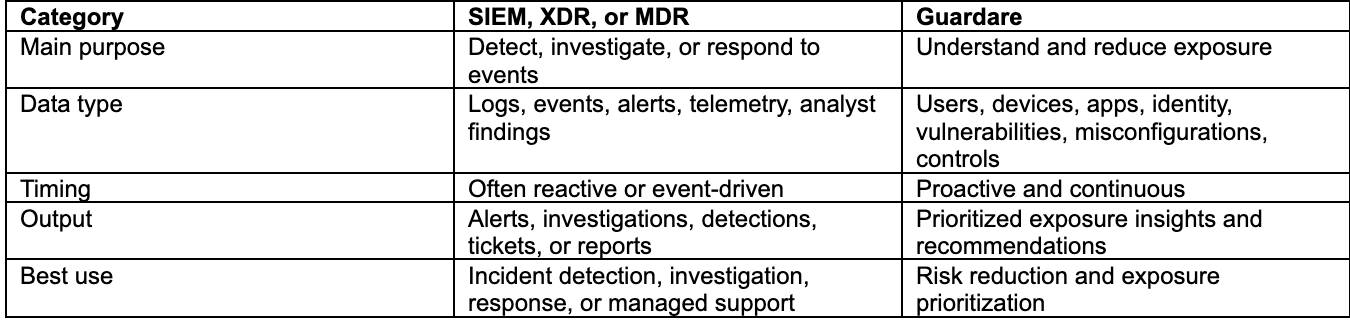
The two can work together. Detection and response tools can help show what is happening. Guardare can help reduce the conditions that make incidents more likely.
When Brinqa May Still Be the Right Fit
Brinqa may be a strong fit when:
- Enterprise teams looking to unify many data sources into a cyber risk and exposure program.
- You already use Brinqa Cyber Risk Graph
- Your current security or IT workflow is built around Brinqa
- Your team has the maturity and staffing to operationalize the platform
- Your current process is working and switching would add unnecessary friction
When Guardare Is the Better Fit
Guardare is a better fit when:
- You need more than vulnerability counts, alerts, asset lists, or workflow tickets
- You want to connect users, devices, applications, identity, and tools
- You need clearer prioritization
- You want to uncover misconfigurations and underused security features
- Your team is overwhelmed by disconnected dashboards
- You need executive-ready exposure reporting
- You want practical recommendations, not just findings
- You are trying to answer, “What should we fix first?”
How to Evaluate Brinqa Alternatives
When comparing Brinqa competitors, ask:
- Does the platform only find issues, or does it explain exposure?
- Can it connect users, devices, applications, identity, and security tools?
- Does it prioritize based on context or mostly severity, alerts, or asset counts?
- Does it identify misconfigurations and control gaps?
- Does it reduce tool sprawl or create another console?
- Does it help teams take action?
- Can executives understand the reporting?
- Does it help prevent incidents, or only detect them after the fact?